Donghwasa Temple in Daegu: Stone Bridges, Courtyards and Palgongsan Rooflines
Donghwasa Temple, Daegu — a wooded temple setting below Palgongsan’s hiking routes
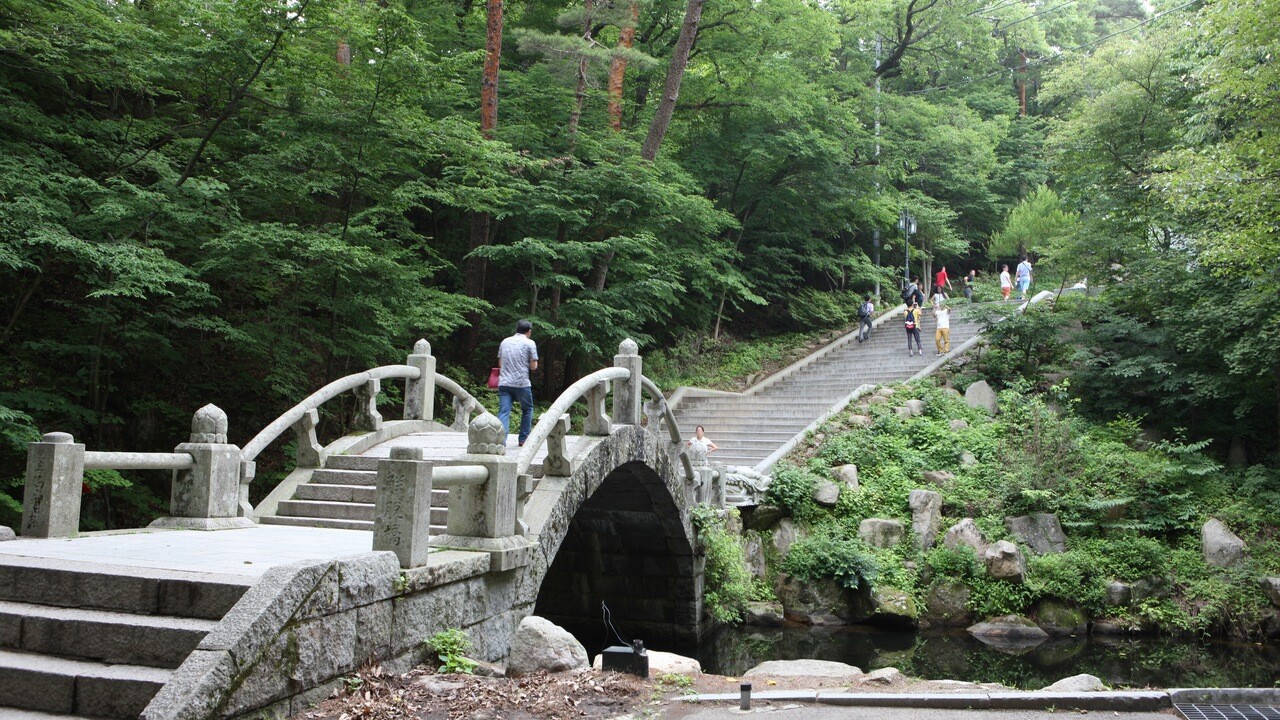
A stone bridge crosses a narrow watercourse beneath a dense canopy. Beyond it, steps rise into the trees. Donghwasa’s temple scenery unfolds through changes in level and through the spaces between buildings.
Donghwasa Temple in Daegu belongs to the Palgongsan mountain setting on the northeastern side of the city. It is a different temple from Donghwasa in Cheongju. Visiting the courtyards also differs from planning a climb to Palgongsan’s ridges.
For a fall itinerary, the useful starting point is the layout of the place. The green woodland in these photographs illustrates that setting; it does not establish the leaf color for a particular travel date. A visit can focus on bridges, rooflines and stonework without depending on a verified foliage peak.
A small gate changes the scale of the view
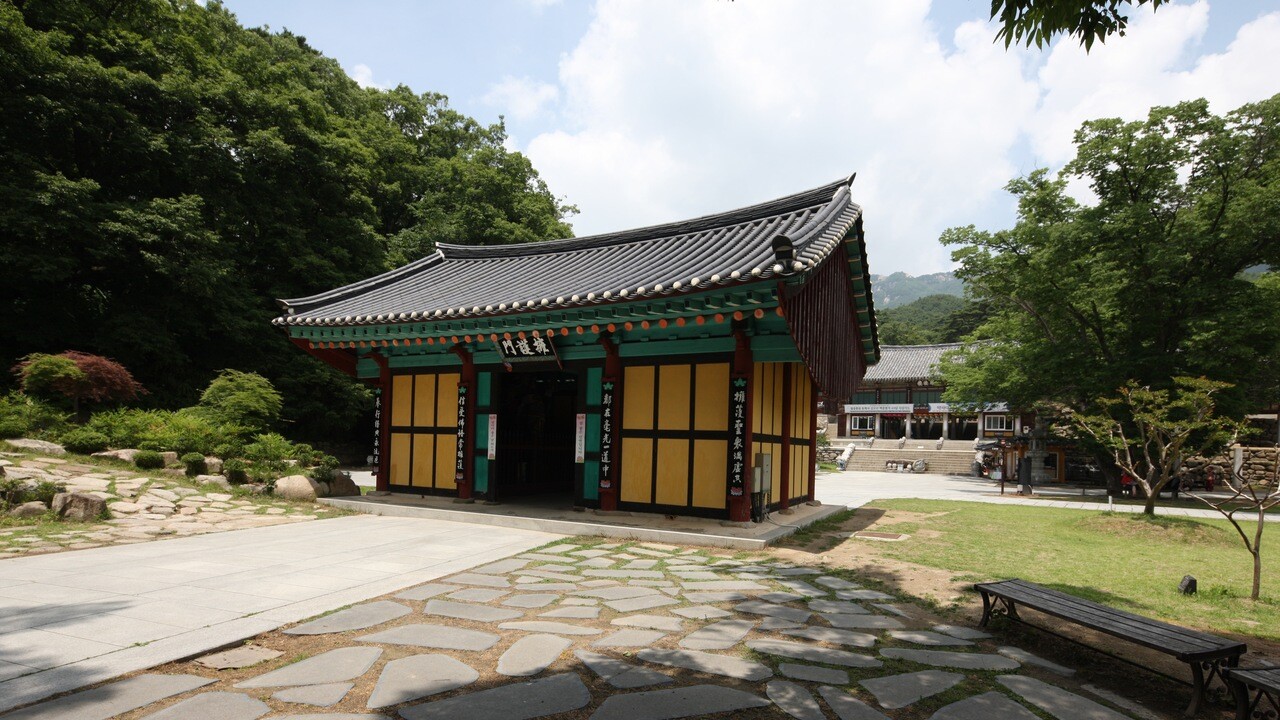
A compact gate stands between the woodland and a paved open space. From outside, the trees frame its roof. Through the opening, the view begins to include the courtyard and neighboring buildings.
This pictured gate should not be treated as the only entrance to the whole complex. Its value in the scene is the change it creates: enclosed shade gives way to an open walking space.
Look at the nearby roof and the ground beneath it before widening the view toward the mountain. That shift brings the setting into a scale that a distant landscape photograph cannot explain.
Bongseoru Pavilion rises above its stone base
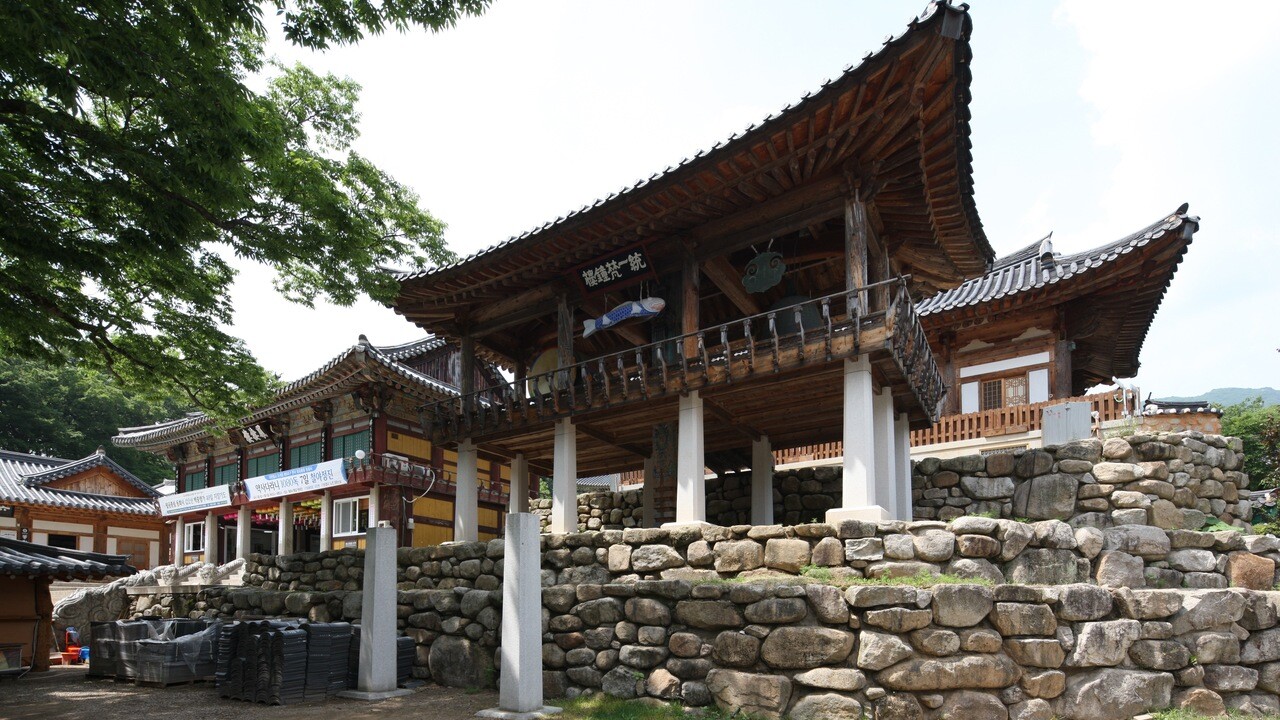
Bongseoru’s wooden structure stands above substantial stonework. The roof appears broad from below, while the steps and uneven stones reveal how the building sits above the courtyard.
The temple’s official grounds plan identifies Bongseoru, Daeungjeon Hall and Haetalgyo Bridge as distinct parts of the complex. It helps separate the buildings and crossings rather than treating the temple as a single landmark.
As the viewpoint rises toward a terrace, a roof that was overhead moves closer to eye level. The relationship between buildings changes even over a short distance. Donghwasa’s courtyards are worth looking at from more than one height.
Daeungjeon brings the stone steps into the foreground
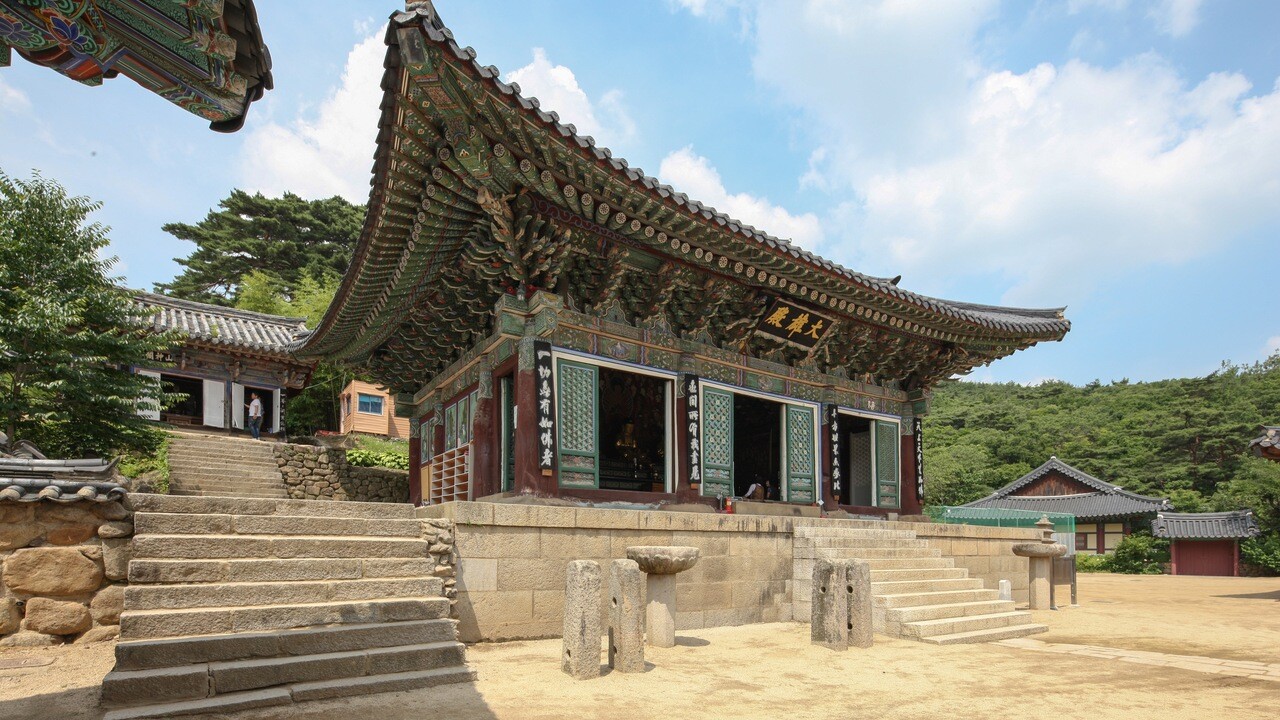
Daeungjeon stands above the open ground, with steps leading toward its painted woodwork. The eaves reach forward, while the trees behind them provide a darker outline.
The Korea Tourism Organization describes most surviving halls as buildings from the rebuilding period under King Yeongjo in the eighteenth century. The institution’s much earlier foundation does not mean that every structure visible today dates from that foundation.
A close view makes that distinction tangible. Columns, doors and the curve of the roof are part of the surviving architecture. The steps show how it is arranged in the landscape.
A narrow passage reveals the texture of the walls
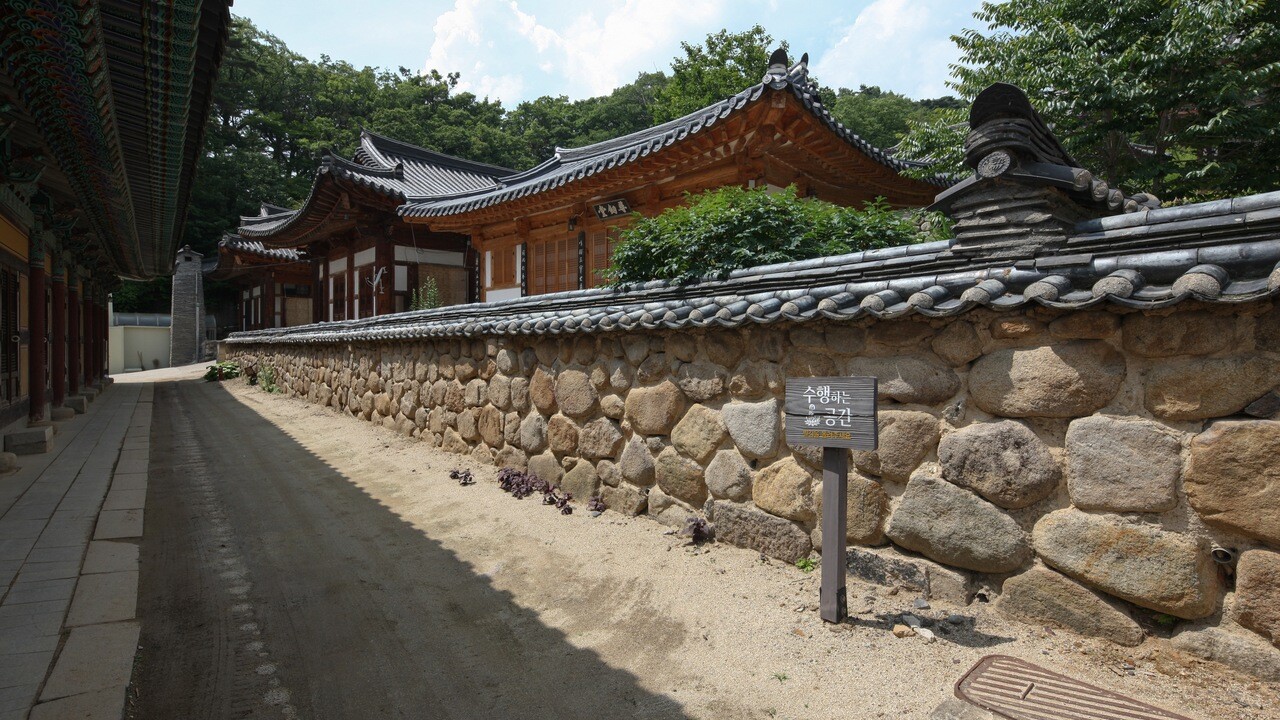
Along a narrower passage, rough stones sit below a line of roof tiles. The wall and the neighboring eaves frame the walking space instead of opening it toward a panorama.
The pictured sign also indicates that this is a working religious place. Visitor areas and spaces used for practice or daily life coexist. A photogenic passage is not permission to enter every part of the compound.
Here the scene is about texture and repetition: irregular stone faces, rows of tiles and the shadow of a roof. Those details offer another way to see a mountain temple.
Donghwasa Temple courtyards and rooflines
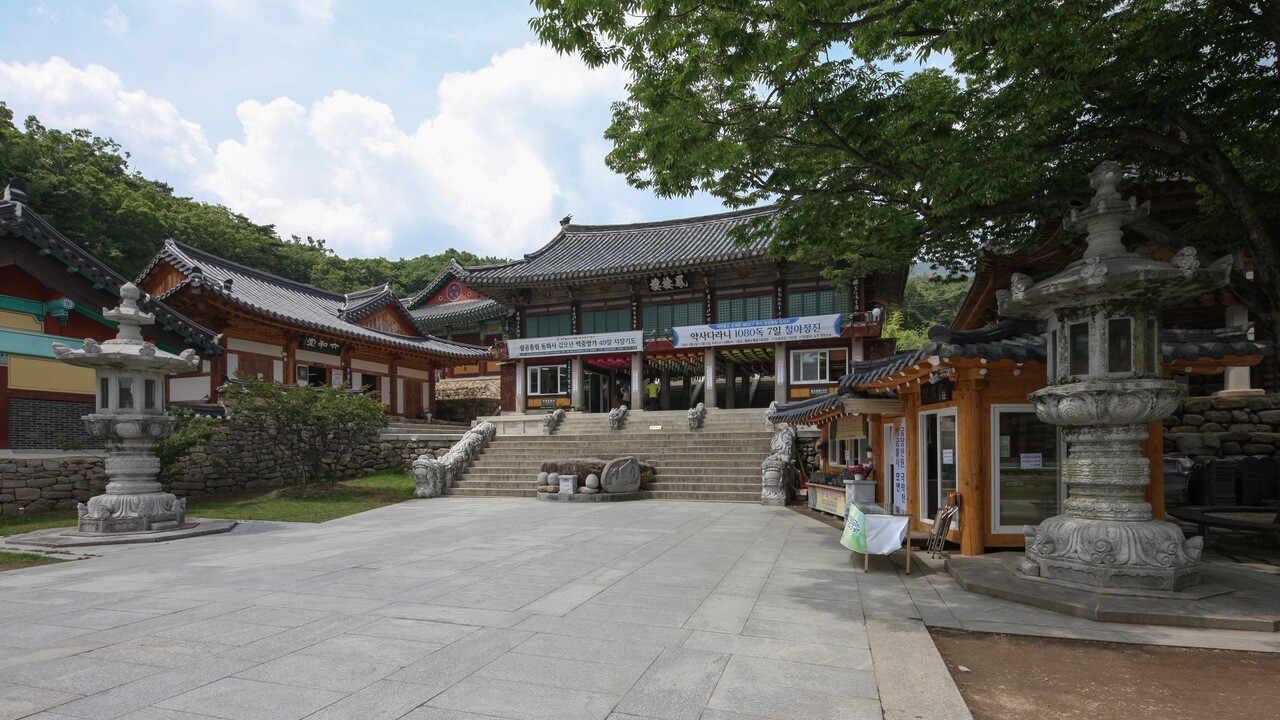
An open courtyard brings several buildings back into one view. Roofs overlap at different heights, and the steps show the levels connecting them. The place begins to read as a sequence of spaces rather than a list of halls.
Palgongsan hiking access requires a separate check. The Korea National Park Service construction notice lists restrictions on Sutaegol–Cheoltap Junction, Pagyesa–Pagyejae and Haneul Garden–Birobong. A temple visit should not be read as confirmation that summit routes are open.
For a separate mountain-temple setting, compare Cheongnyangsa’s rock peaks and courtyards in Bonghwa. At Donghwasa, the distinctive transition is closer to the ground: across water, past stonework and into the spaces beneath the roofs.
You May Also Like
by Google Adsense