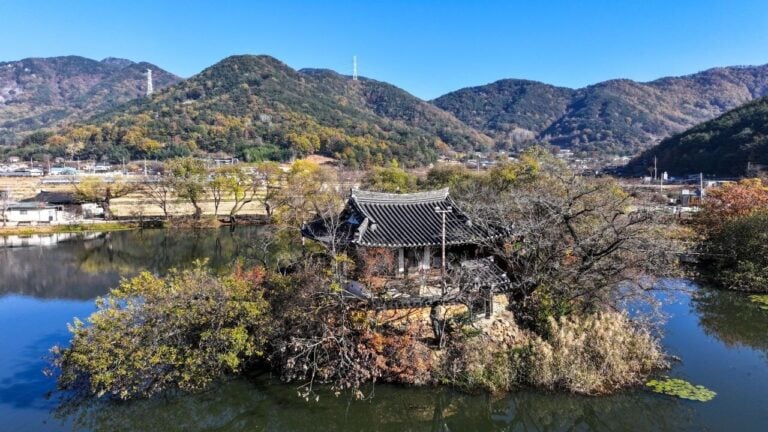
Sangnim Forest in Hamyang: Autumn Leaf Paths, Old Trees and Waterside Views
Sangnim Forest, Hamyang — a historic riverside woodland seen from its paths and quieter edges
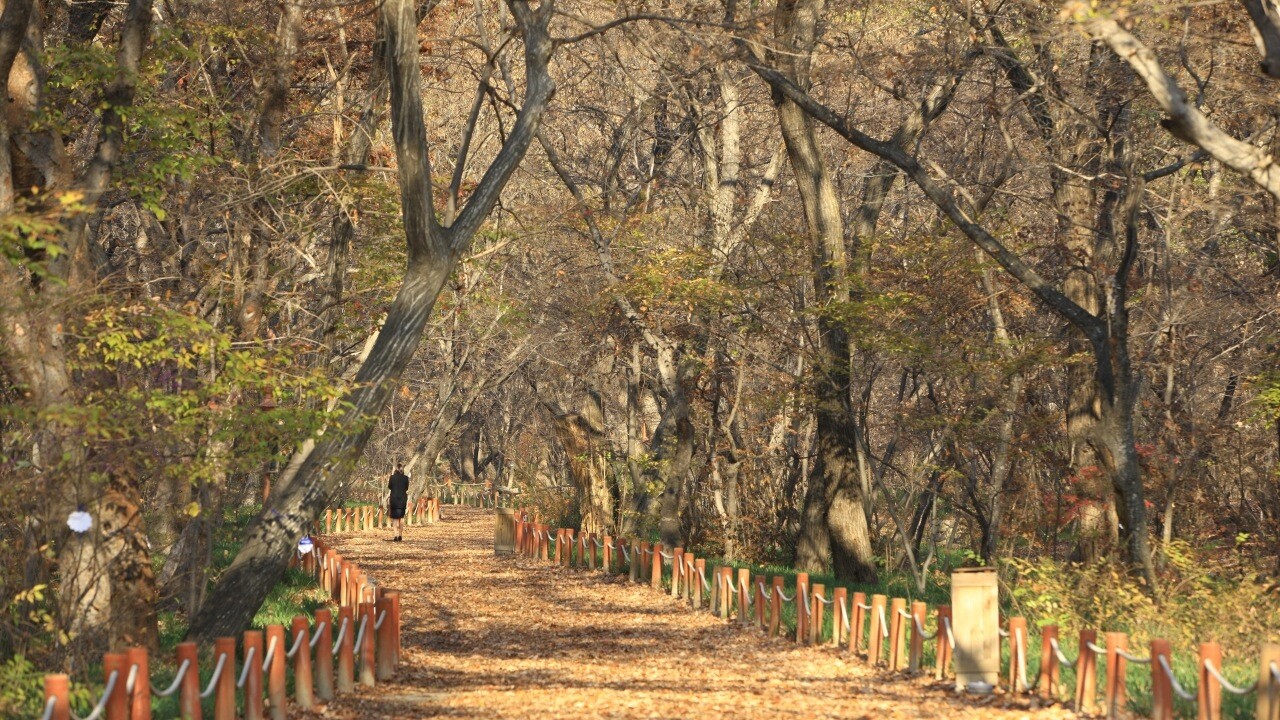
Curving branches cross above a narrow path. Below them, fallen leaves gather between low posts and ropes. The autumn landscape continues at ground level after the canopy has begun to open.
Sangnim Forest, also called Sangnim Park, lies beside the Wicheon in Hamyang. This is a woodland setting near the town rather than a summit hike. Its paths bring attention to the space between trunks and the changing texture underfoot.
Hamyang County’s official park introduction records a tradition that the scholar-official Choe Chiwon planted the forest as part of flood protection. Trees along the embankment became a landscape with a practical relationship to the town and river.
The county describes a woodland extending about 1.6 kilometers, roughly one mile. That is the forest’s extent, not a measured distance for every walking route. The point of the setting is its varied canopy and closer views, rather than completing a fixed circuit.
Sangnim Forest’s irregular canopy
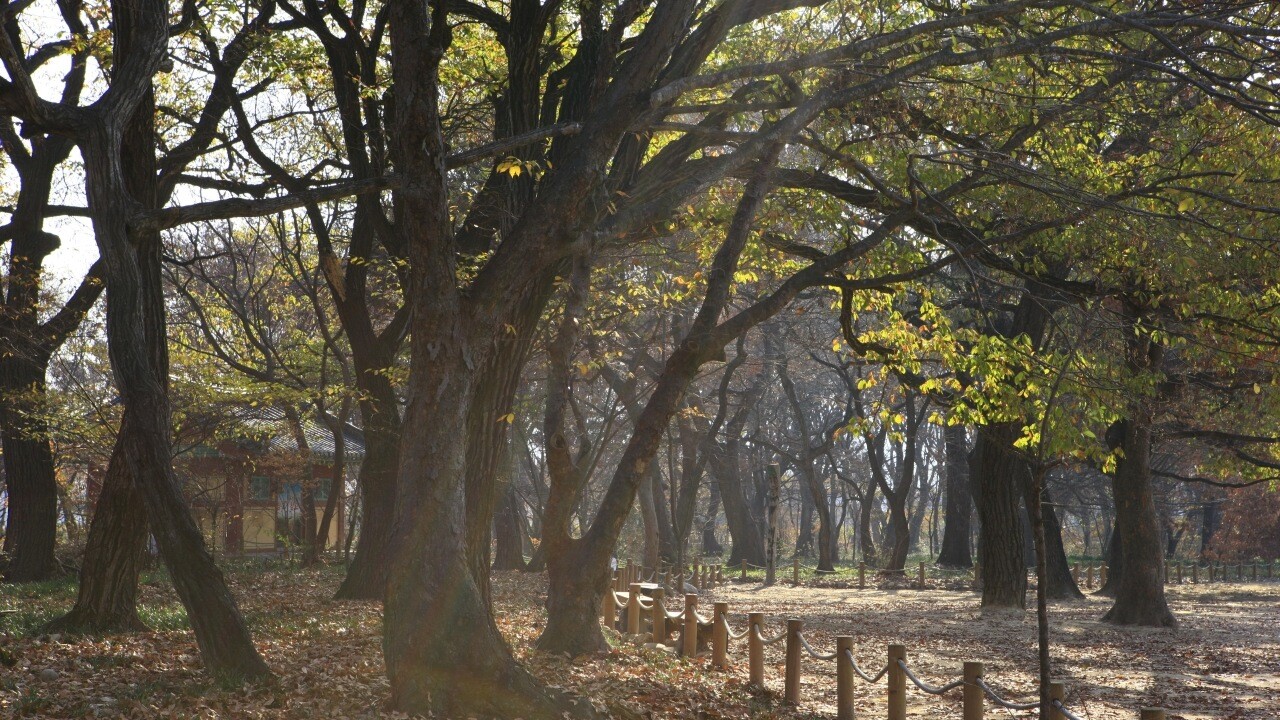
Nearby trees partly conceal the path, while more trunks overlap in the light behind them. Their spacing is irregular. Small changes in position open a different view instead of extending one perfectly straight line.
The forest was established beside an embankment and contains several kinds of deciduous trees. Its branching shapes help explain the difference between a mixed woodland and an avenue planted with a single species.
Some trees retain leaves while others reveal more of their structure. Those variations give a fall visit several subjects without requiring a promise that every tree will reach peak color together.
Fallen leaves as a closer landscape

At ground level, the scale contracts from whole trees to individual leaf edges. Sunlight catches one layer while another falls into shade. The path becomes a surface of overlapping shapes.
This is a different autumn view from a broad canopy photograph. A woodland can retain color and texture after many leaves have fallen, especially where the path leads through several patches of light.
Lowering the view changes the subject from a tall canopy to a much closer landscape. The variations between dry leaves, dark ground and patches of light reward a different kind of attention.
A small tiled building among the trees
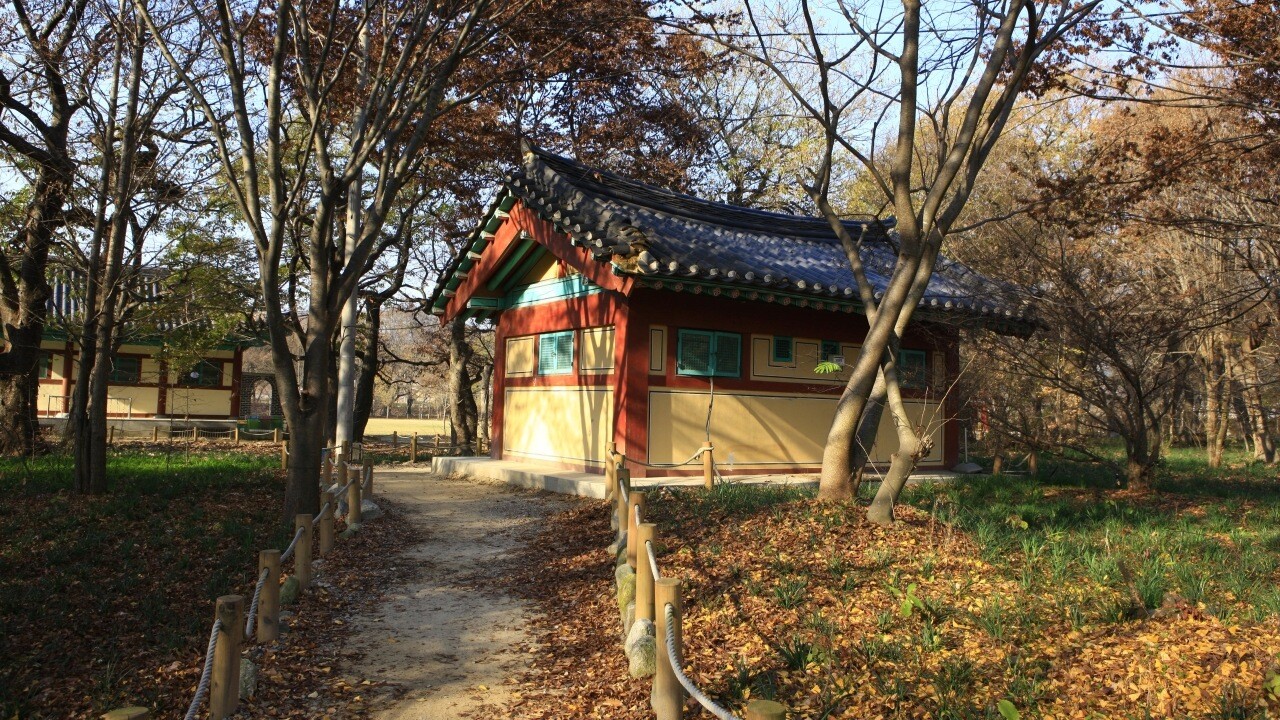
A low roof and pale yellow walls sit beneath much taller branches. The path bends in front of the building, keeping the trees in the foreground. Architecture provides a smaller scale against the woodland.
The county traces Sangnim’s earlier identity to Daegwallim, a larger forest later divided into upper and lower sections after damage to its middle. That history gives the present name a context beyond a modern park label.
The regular roof edge contrasts with branches growing in several directions. Its small place among the trees is the subject here, giving the woodland a different sense of scale.
Water and the edge of the woodland
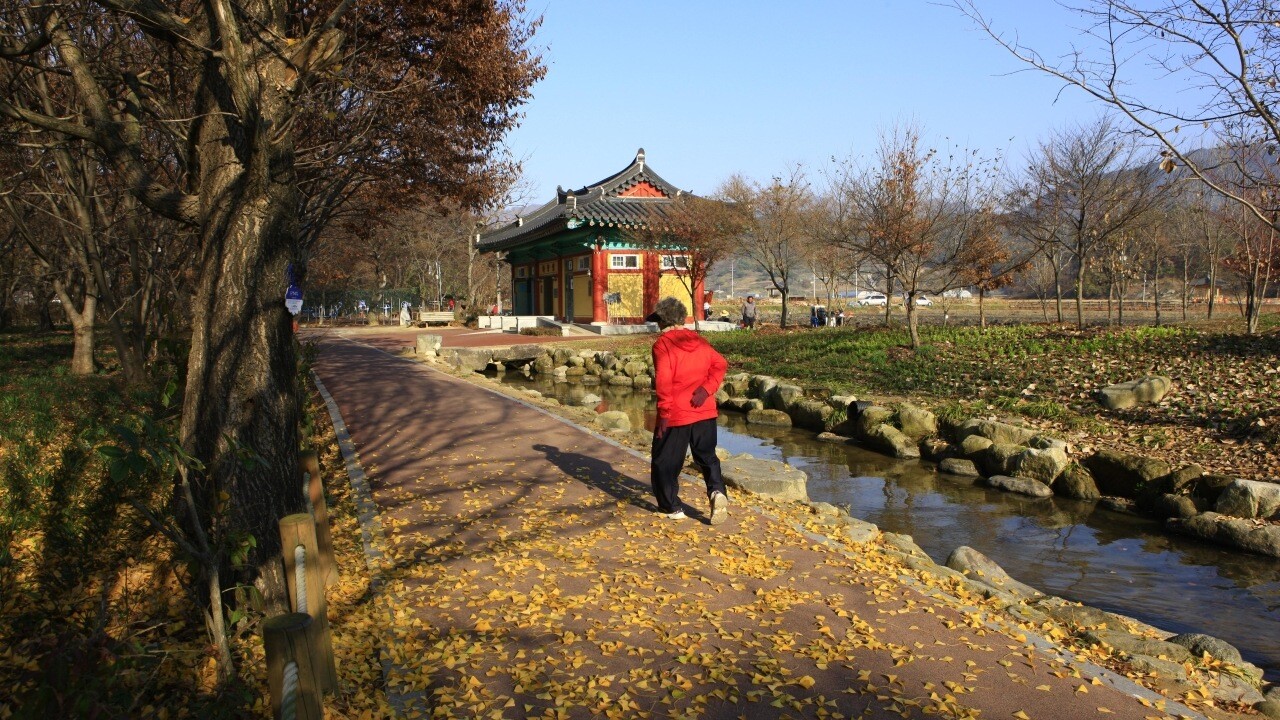
At the forest’s edge, the sky opens and a low watercourse runs beside the path. Stones mark the boundary of land and water. The tiled roof appears farther away instead of being enclosed by nearby trunks.
Knowing the flood-protection tradition makes water more than a decorative detail in the wider story. The forest’s origin adds a reason to notice its edges and the meeting point between land and water.
The change between shade inside the woodland and brighter ground outside it is part of Sangnim’s appeal. Looking toward the edge reveals another relationship between trees, paths and open space.
An autumn walk beyond one color peak
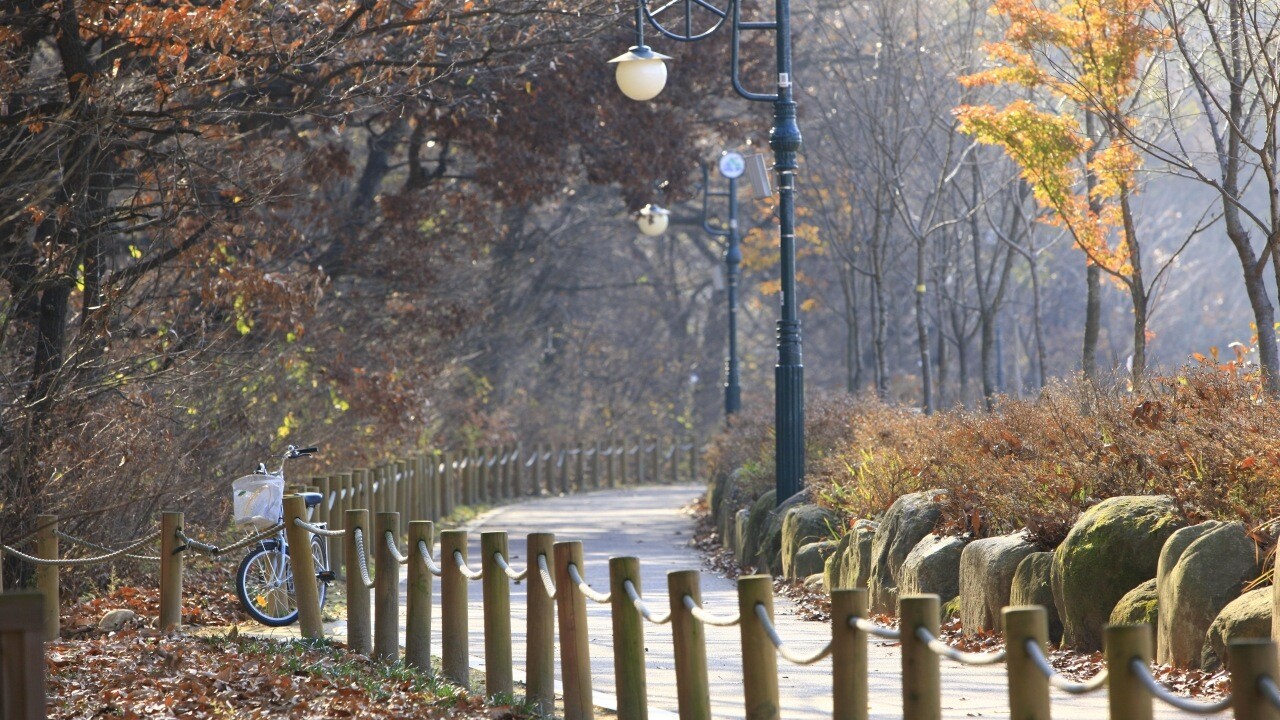
Stones, lamps and a low barrier follow the edge of the path. Leaves and bare branches overlap beyond them, giving the view several distances rather than a single flat wall of trees.
For a contrasting landscape, Asan’s Gokgyocheon Ginkgo Tree Road emphasizes the regular spacing of an avenue. Sangnim’s mixed woodland offers less predictable lines and smaller openings. The contrast helps distinguish two kinds of planted landscape.
Sangnim suits a fall trip centered on close observation: a curved branch, a layer of leaves and an opening toward water. Those subjects remain worth noticing without choosing the park solely around a forecast peak day.
You May Also Like
by Google Adsense